Introduction
You pull your fitted sheet out of the dryer and stretch it across the mattress. The corners don’t align properly, the embroidery looks slightly off, and the sheet already feels warped.
Warping is a common issue with bamboo bedding, and the usual advice — “wash cold” or “air dry only” — rarely addresses the real cause. So the real question is: can plain weave bamboo embroidered bedding actually resist warping, or is it just another marketing claim?
The short answer is yes — but only when fiber quality, weave structure, and manufacturing precision work together as a system. To understand why, we need to break down what actually causes warping and how this construction prevents it.
Understanding Warping: Distinguishing Between Shrinkage, Stretching, and Dimensional Deformation
Before we can evaluate warp resistance, we need to be clear about what warping actually is. Most people use the term loosely, but in textile science, warping refers to a specific type of dimensional distortion — when a fabric no longer retains its original shape or alignment after washing, use, or mechanical stress.
Here’s the crucial distinction that most bedding buyers miss:
Shrinkage — The fabric gets smaller overall. Usually caused by heat and moisture relaxing fiber tension. Most natural fabrics shrink 3–5% in the first few washes. This is normal to a degree, but excessive shrinkage (above 8%) indicates poor pre-treatment.
Stretching — The fabric gets permanently elongated in certain directions. Usually caused by mechanical tension during use or improper washing cycles with high spin speeds.
Warping (true dimensional deformation) — The fabric distorts unevenly. Corners no longer line up. The embroidery shifts off-center. The sheet takes on a rhomboid rather than a rectangular shape.
Here’s the important thing to understand. Warping is not inevitable with bamboo bedding. It is the result of specific failures: weak fiber structure, loose weave construction, poor pre-shrinking treatment, or improper care. Plain weave bamboo embroidered bedding is designed to address these exact points, providing better dimensional stability than many other bamboo bedding options.

The Fiber Property Edge: How Bamboo’s Natural Strength Resists Distortion
Let’s start with the foundation — the fiber itself. Before weave or embroidery comes into play, the raw material‘s mechanical properties determine how much stress the fabric can absorb without permanent deformation.
Here’s what the data shows. Bamboo fiber has a tensile strength of approximately 575 MPa, compared to cotton at 500 MPa. That’s roughly 15% stronger than cotton on a per-fiber basis. But strength alone isn’t the whole story. Bamboo also has a Young’s modulus of 27 GPa — meaning it’s stiffer and less prone to elastic deformation under tension.
In plain English: bamboo fibers resist being pulled out of shape better than cotton fibers do. When you stretch a bamboo sheet across a mattress, the fibers themselves fight back against distortion. Plain weave bamboo embroidered bedding leverages this fiber property to maintain alignment and reduce warping during use.
But here’s where it gets interesting. Not all “bamboo bedding” uses the same fiber processing method. This distinction matters enormously for warp resistance.
Bamboo viscose (also called “rayon from bamboo”) uses an open-loop chemical process. The resulting fibers are hollow, which gives bamboo its breathability, but that same structure makes them about 50% weaker when wet. Wet weakness is a major contributor to warping, because most dimensional distortion happens during washing, when fibers are saturated and most vulnerable.
Bamboo lyocell, by contrast, uses a closed-loop process with a non-toxic solvent called NMMO. Over 99% of the solvent is recovered and reused. The resulting fiber is stronger, more dimensionally stable, and better at handling moisture without distortion. This is why plain weave bamboo embroidered bedding made with bamboo lyocell offers superior warp resistance compared to traditional bamboo viscose sheets.
Why Plain Weave Construction Creates Superior Dimensional Stability
Now let’s talk about the weave. This is the most underrated factor in warp resistance, and it’s where many bedding products fall short.
Plain weave is the simplest and oldest weaving structure. The warp and weft yarns interlace in a one-up, one-down pattern — every single yarn crosses over and under the adjacent yarn. This creates the maximum number of interlacing points per square inch.
Why does that matter for warp resistance? Because each interlacing point acts like a tiny lock, holding adjacent yarns in place. When a fabric has more interlacing points, individual yarns have less freedom to shift or slide past each other under tension.
Here’s what textile engineers know about plain weave that most consumers don’t:
-
Higher stretch resistance — Densely woven plain weave bedding can withstand greater tension without being easily deformed or damaged.
-
Elastic recovery — The fiber structure retains a degree of elasticity and can quickly return to its original shape after being stretched.
-
Wrinkle reduction — Better elastic recovery means the bedding maintains a smooth, flat appearance and is less prone to wrinkles.
Compare this to other common bedding weaves:
| Weave Type | Interlacing Pattern | Warp Resistance | Softness | Breathability |
|---|---|---|---|---|
| Plain weave | 1 up / 1 down (maximum interlacing) | Excellent | Firm, crisp | High |
| Percale (a type of plain weave with a higher thread count) | 1 up / 1 down, tighter construction | Excellent | Smooth, matte | High |
| Twill | 2 up / 1 down or similar | Good | Softer | Moderate |
| Sateen | Long weft floats (4 up / 1 down) | Lower | Very soft | Lower |
Plain weave’s firmness is actually an advantage for warp resistance. A looser weave — like some sateen constructions — allows more yarn movement, which translates to a higher risk of distortion over time. Plain Weave Bamboo Embroidered Bedding leverages this structural advantage to maintain shape through repeated washing and use.
Here’s the key takeaway. Plain weave doesn’t rely on chemical treatments to resist warping. It relies on physics — the geometry of the yarn interlacing itself.
How Embroidery Changes Fabric Dynamics And What Prevents Distortion
Embroidery adds another layer of complexity to warp resistance. And this is where many manufacturers get it wrong.
When you stitch a decorative pattern onto a fabric, you are perforating the weave with thousands of needle penetrations. Each stitch creates a tiny hole. The thread tension pulls on the surrounding yarns. If the base fabric isn‘t stable enough to absorb this stress, the embroidery will distort — and worse, the distortion can become permanent.
Here’s what happens at the mechanical level. Dense stitch patterns — like satin stitches or heavy fill designs — generate significant tension in the fabric. Without proper stabilization, this tension causes the fabric to shift, pucker, or stretch during stitching. The result is an embroidered motif that looks fine on the production line but gradually pulls the surrounding fabric out of alignment over time.
So how does Plain Weave Bamboo Embroidered Bedding avoid this trap?
The answer lies in three factors:
First, fabric stabilizers are used during the embroidery process. Stabilizers — whether cut-away, tear-away, or water-soluble — act as a foundation, holding the fabric securely while the embroidery machine stitches out the design, eliminating distortion in both the fabric and the design.
Second, stitch density is controlled. Dense embroidery on lightweight fabric is a recipe for distortion. Quality manufacturers adjust digitization parameters — reducing stitch density or increasing pull compensation — specifically for bamboo lyocell’s characteristics.
Third, the plain weave base itself is inherently more resistant to embroidery-induced distortion than looser weaves. Because plain weave has more interlacing points, the fabric structure is less likely to shift under the mechanical stress of embroidery.
A critical industry detail: On stretchier or more elastic fabrics — which some bamboo blends can be — embroidery distortion risks are higher. That‘s why reputable manufacturers use a combination of proper stabilizer selection, tension calibration, and design digitization to ensure the embroidery enhances the product without compromising its structural integrity. Plain Weave Bamboo Embroidered Bedding follows these best practices.
The Role of Pre-Treatment and Finishing in Preventing Warping
Even the best fiber and weave will warp if the manufacturer skips essential pre-treatment steps.
High-quality bamboo bedding goes through a multi-stage finishing process specifically designed to stabilize the fabric dimensions. Here’s what that process looks like:
-
Mercerization or liquid ammonia treatment — These processes swell the fibers and align their molecular structure, which reduces future shrinkage and improves dimensional stability. The treatment essentially “pre-shrinks” the fabric so it doesn’t shrink on the customer.
-
Pre-shrinking (sanforization) — The fabric is mechanically compressed before cutting and sewing. This step alone can reduce residual shrinkage from 5–8% down to 1–3%.
-
Heat-setting — For bamboo lyocell specifically, heat-setting locks in the fabric dimensions, reducing both warp and weft distortion risk.
-
Tension control during finishing — If the fabric is stretched on the finishing line, it will relax in the customer’s first wash. Quality manufacturers maintain neutral tension throughout.
Chinese National Standard GB/T 22796-2021 establishes specific requirements for bedding dimensional stability and appearance quality. Products that meet this standard have passed testing for shrinkage, skewness, and dimensional change after laundering.
Here’s what this means for Plain Weave Bamboo Embroidered Bedding. When properly pre-treated and finished, the product emerges from the factory already dimensionally stable. The first wash doesn’t cause a shock of shrinkage or warping — because those changes have already been engineered out.
Without this pre-treatment, even the best plain weave bamboo bedding will warp. With it, the product maintains its shape through years of regular use. Plain Weave Bamboo Embroidered Bedding incorporates these finishing processes as standard practice.
Comparative Analysis: Resistance to Warping Across Leading Bedding Fabrics
Let’s put warp resistance into perspective by comparing bamboo lyocell plain weave against other common bedding materials.
| Material & Weave | Wet Strength | Dimensional Stability | Shrinkage Risk | Warp Resistance |
|---|---|---|---|---|
| Cotton plain weave (standard) | Good | Moderate | 3–5% | Good |
| Cotton percale (high thread count) | Good | Good | 2–4% | Very good |
| Bamboo viscose sateen | Poor (50% weaker wet) | Moderate | 5–8% if untreated | Fair |
| Bamboo lyocell plain weave | Good | Good | 2–4% with pre-treatment | Excellent |
| Linen plain weave | Very good | Good | 3–6% | Excellent |
| Polyester microfiber | Excellent | Excellent | 1–2% | Excellent (but different feel) |
Here’s what this comparison reveals. Plain Weave Bamboo Embroidered Bedding, built from bamboo lyocell with proper pre-treatment, sits at or near the top of warp resistance among natural fiber bedding options. It doesn’t match polyester’s dimensional stability — no natural fiber does —, but it outperforms standard cotton and bamboo viscose significantly.
The trade-off is worth noting. Polyester microfiber won’t warp. But it also doesn’t breathe like bamboo. It doesn’t wick moisture. And for many sleepers, it sleeps hot. Bamboo lyocell plain weave offers the best balance — excellent warp resistance combined with bamboo’s natural breathability and moisture management. That’s precisely what Plain Weave Bamboo Embroidered Bedding delivers.
What Buyers Should Check When Sourcing Warp-Resistant Bamboo Bedding
If you’re a brand, retailer, or designer considering Plain Weave Bamboo Embroidered Bedding, here is your quality checklist.
First, verify the fiber type and processing. Ask for documentation confirming bamboo lyocell (not bamboo viscose). The difference matters for wet strength and dimensional stability. A reputable supplier should be transparent about which manufacturing process is used.
Second, request shrinkage test data. Industry best practice is residual shrinkage below 3% in both warp and weft directions after three washes. If the supplier can’t provide this data, that’s a red flag. Chinese National Standard GB/T 22796-2021 provides specific acceptance criteria for bedding dimensional stability — ask if the product meets this standard.
Third, examine the plain weave density. Higher thread count within the plain weave structure generally means better dimensional stability. For bedding, look for 200 thread count or higher in plain percale construction.
Fourth, inspect the embroidery technique. Ask about stabilizer use, digitization parameters, and whether pull compensation was applied. For bamboo lyocell specifically, proper embroidery stabilization is essential to prevent long-term distortion around stitched areas. A test swatch should show no puckering or misalignment under tension.
Fifth, check the finished fabric, not just raw fiber specs. A fiber specification sheet tells you what went into the process. Finished fabric testing — including dimensional change after laundering and skewness measurement — tells you what the end user will actually experience.
Care Practices That Extend Warp Resistance And What Voids It
Here is the truth. Even the best Plain Weave Bamboo Embroidered Bedding can be ruined by improper care. And most care label instructions are too vague to actually help.
Based on documented user experience and textile science, here are the specific practices that preserve dimensional stability:
-
Wash in cold water only. Warm water causes bamboo fibers to swell and shrink, leading to wrinkling and distortion. This is non-negotiable.
-
Use a gentle cycle with a spin speed under 600 RPM. Many washing machines’ “delicate” cycles still spin at 800 RPM — that is too aggressive. Manually reduce the spin speed if needed.
-
Never use hot water. Hot water breaks down the fiber structure and accelerates warping.
-
Avoid fabric softeners and bleach. Softeners leave residue that builds up on bamboo fibers, while bleach chemically degrades the cellulose structure.
-
Air dry or tumble dry on low heat only. High heat is one of the fastest routes to permanent warping. Line drying preserves dimensional stability best.
Here’s what the data says about first wash expectations. Some initial shrinkage — typically 2–4% — is normal even for pre-treated bamboo lyocell. Quality manufacturers account for this by cutting sheets slightly oversized. One supplier notes: “Our sheets come oversized to account for the natural shrinkage that occurs within the first few months”. This is a sign of thoughtful engineering, not a defect.
The difference between a sheet that warps permanently and one that settles into its intended size after the first wash often comes down to whether the manufacturer anticipated this shrinkage in the cutting stage. Plain Weave Bamboo Embroidered Bedding is designed with this tolerance built in.
Can Plain Weave Bamboo Embroidered Bedding Resist Warping?
Plain Weave Bamboo Embroidered Bedding resists warping when fiber selection, weave construction, finishing, and embroidery control are properly executed.
What actually matters is simple:
- Bamboo lyocell instead of bamboo viscose for better wet stability
- A true plain weave with tight interlacing for structural hold
- Proper pre-shrinking and heat-setting before cutting and sewing
- Embroidery done with controlled tension and stabilizers
- Care instructions that reflect how the fabric behaves in real use
Warping is almost inevitable with low-grade viscose blends, loose construction, skipped finishing steps, or generic “cold wash only” instructions. In those cases, distortion usually appears after a few wash cycles.
Bamboo lyocell plain weave behaves differently. It maintains its structure under tension and repeated washing. Combined with careful finishing and embroidery, the fabric stays aligned where cheaper constructions would fail.
Stop Settling for Sheets That Lose Their Shape
Sheets that twist after washing, corners that don’t fit, or embroidery drifting out of place are usually the result of materials and finishing, not chance.
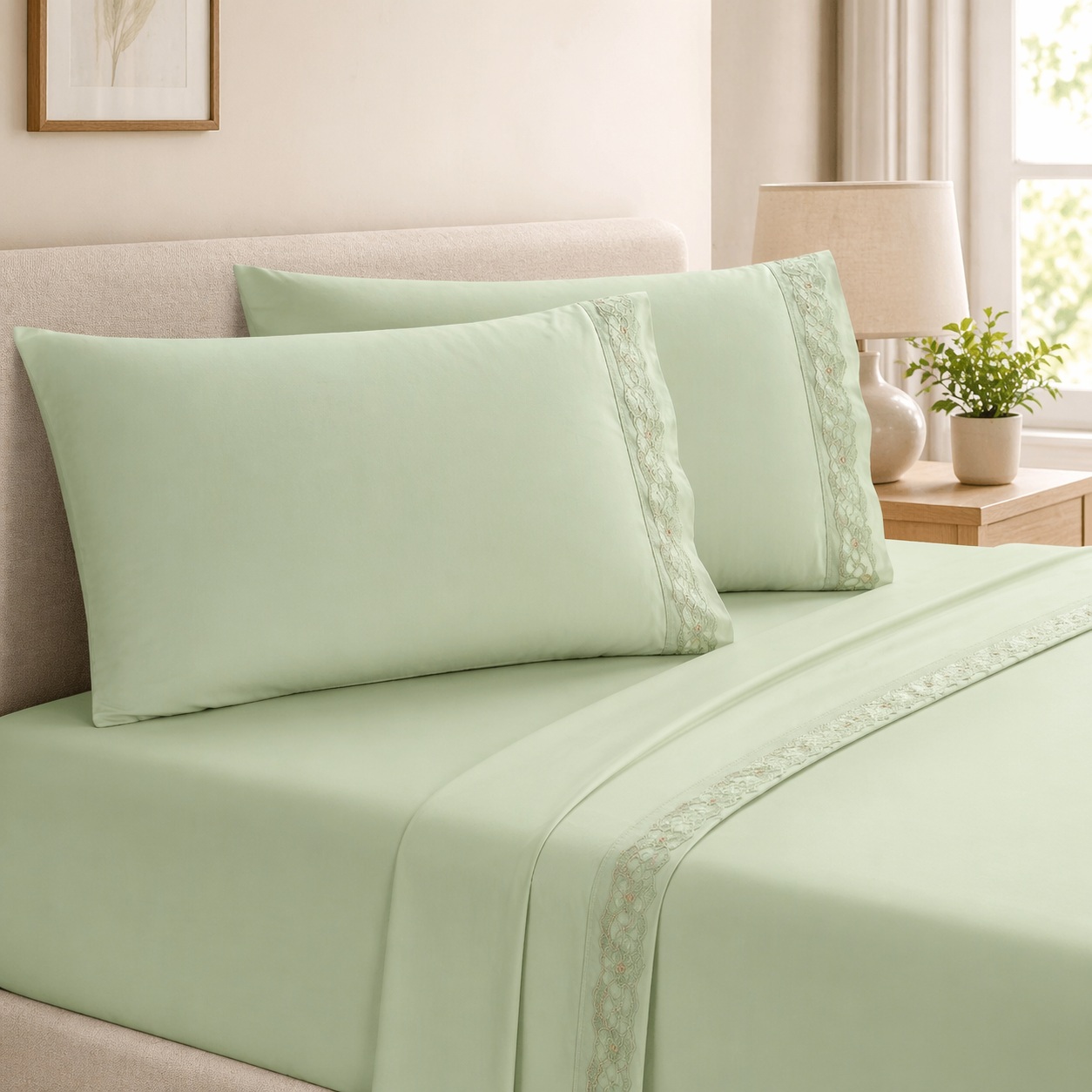
Plain Weave Bamboo Embroidered Bedding made with bamboo lyocell and proper finishing keeps its form because stability is engineered into the fabric from the start. The difference shows after repeated use, not just on day one.
For sourcing or product design, specifications, finishing details, and embroidery control are critical. Checking these upfront prevents distortion problems later.
Visit the Plain Weave Bamboo Embroidered Bedding product page to review technical details, request samples, and ensure it fits your application.
Choose fabrics that are built to hold their shape, not ones that rely on hope and careful washing.