Introduction
A bamboo cooling bedding set is designed to help hot sleepers stay cooler by improving breathability, moisture control, and heat dissipation compared to traditional cotton bedding.
If you often wake up sweaty or struggle with overheating at night, switching to a bamboo cooling bedding set can significantly improve sleep comfort. Bamboo-derived fabrics are widely recognized for their natural moisture-wicking and temperature-regulating properties, making them a popular choice for summer bedding.
Independent textile studies suggest bamboo fabrics may dissipate heat faster than standard cotton, helping maintain a cooler sleep environment throughout the night. This is why many consumers searching for the best bamboo cooling bedding set prefer bamboo over cotton percale.
This guide explains what makes a bamboo cooling bedding set effective, how it compares to cotton, and how to choose the right option for different needs, such as queen or king size bedding.
What a Bamboo Cooling Bedding Set Actually Is
Not all bamboo bedding is created equal. A true bamboo cooling bedding set is made from bamboo-derived fibers — typically bamboo viscose or bamboo lyocell — that retain the natural properties of the bamboo plant. When you see a cooling bedding set labeled as “bamboo,” it means the fabric has been processed from bamboo pulp into soft, breathable textile fibers. The question is rarely whether a bamboo cooling bedding set works; the data consistently show it does.
Viscose vs. Lyocell – What to Look For
When researching the best bamboo cooling bedding set, you will encounter two main processing methods. Understanding the difference helps you choose options that match your priorities.
-
Bamboo viscose – The most common and affordable option. Absorbs 40% more moisture than cotton, is naturally thermoregulating, and feels incredibly soft. In direct comparisons, bamboo viscose sheets consistently register lower surface temperatures during sleep than cotton. However, viscose production requires chemical processing that some environmentally conscious buyers prefer to avoid.
-
Bamboo lyocell – Uses a closed-loop manufacturing system that recycles over 99% of solvents, making it significantly more eco-friendly. Lyocell retains more of bamboo’s natural cooling properties, offers superior fabric strength, and provides even better moisture management. Independent lab tests have shown that lyocell fibers maintain lower surface humidity levels after repeated moisture exposure compared to bamboo viscose. The trade-off is higher cost — but for those seeking the best bamboo cooling bedding set without compromising sustainability, bamboo lyocell is the premier choice.
| Feature | Bamboo Viscose | Bamboo Lyocell |
|---|---|---|
| Moisture absorption | 40–60% more than cotton | Superior to viscose |
| Cooling performance | Very good | Excellent |
| Environmental impact | Moderate (chemical process) | Low (closed-loop recycling) |
| Durability | Good | Excellent |
| Price | Affordable | Premium |
Both types deliver genuine cooling and moisture-wicking performance — they simply target different priorities along the quality-and-sustainability spectrum.
Why Bamboo Fiber Naturally Keeps You Cool
The cooling power of a bamboo cooling bedding set starts at the microscopic level. Bamboo fibers are naturally porous with micro-gaps and channels that enhance airflow and moisture transport. According to textile research, bamboo fabric has a thermal conductivity of 0.049 W/m·K and air permeability of 695 mm/s — values that position bamboo as a highly breathable, cooling textile.
Beyond basic breathability, bamboo fibers absorb and wick moisture exceptionally well. Independent studies show bamboo fabric can absorb up to 60% more moisture than cotton before feeling damp. This means that when you sleep hot, a bamboo cooling bedding set actively pulls sweat away from your skin, spreads it across the fabric surface, and accelerates evaporation — which lowers your skin temperature naturally.
Bamboo fibers are also naturally thermoregulating. Unlike synthetics that trap heat, bamboo allows air to circulate freely, promoting consistent airflow across the skin. This is why a bamboo cooling bedding set keeps you cool in summer but can feel cozy in cooler weather — it adapts to your body temperature rather than simply insulating against it.
Breathability and Moisture-Wicking Performance
Let us examine the two most critical performance metrics for a cooling bedding set: breathability and moisture-wicking.
-
Breathability – Refers to how easily air passes through the fabric. In a bamboo cooling bedding set, the hollow structure of bamboo fibers creates natural air channels that prevent heat buildup. This breathability stops you from waking up feeling trapped under a hot blanket. Cotton is breathable too, but bamboo’s micro-porous structure provides a noticeably faster exchange of warm air for cooler ambient air.
-
Moisture-wicking – Arguably even more important for hot sleepers. The average person loses about 0.5 to 1 liter of moisture through perspiration during sleep, and if that moisture stays on your skin or saturates your bedding, it disrupts your sleep cycle. A bamboo cooling bedding set absorbs sweat from the skin, spreads it across a larger surface area, and releases it for evaporation. This rapid wicking is why many sleepers report waking up dry and comfortable after switching to a cooling bedding set.
Textile research confirms that bamboo fibers offer a balance of breathability, moisture-wicking, and comfort that makes them a superior choice for warm-weather textiles. If you are a hot sleeper, these two properties are non-negotiable — and bamboo delivers both in spades.
Thermoregulation Year-Round
One common misconception about a bamboo cooling bedding set is that it only works in summer. In reality, bamboo’s thermoregulating properties make it suitable for year-round use. Unlike synthetic materials that simply trap or reflect heat, bamboo fibers adapt. They allow heat to escape when your body is warm and retain some warmth when the ambient temperature drops.
This dual performance comes from the same porous fiber structure that enables moisture-wicking. The micro-gaps in bamboo fibers create a dynamic insulation layer — one that responds to changes in your body temperature rather than fighting against it. Many users find that a bamboo cooling bedding set stays comfortable across all four seasons, eliminating the need to swap out bedding sets when the weather changes.
For hot sleepers specifically, thermoregulation means fewer episodes of overheating followed by throwing off the covers, then getting cold, then pulling them back on — the classic “tossing and turning” pattern that destroys sleep quality.
Hypoallergenic and Antimicrobial Benefits
Beyond cooling, a bamboo cooling bedding set offers health advantages that cotton cannot match. Bamboo fibers are naturally hypoallergenic and antimicrobial. The bamboo plant contains a bio-agent called “bamboo kun” that resists bacteria and fungi — and this property carries through to bamboo-derived fabrics even after processing.
-
For allergy sufferers, this means fewer dust mites, less mold growth, and reduced exposure to common household allergens. Asthma and allergy patients who switch to a bamboo bedding set for hot sleepers often report fewer nighttime symptoms and improved breathing quality.
-
The hypoallergenic nature of bamboo bedding also makes it an excellent choice for households with pets or young children.
-
Additionally, the moisture-wicking property reduces the damp, humid environment that bacteria and dust mites require to thrive. A dry sleeping surface is a healthier sleeping surface.
This antimicrobial benefit, combined with the cooling effect, creates a uniquely healthy sleep environment that few other bedding materials can replicate.
Bamboo Cooling Bedding vs Cotton
The most common alternative to a bamboo cooling bedding set is, of course, cotton. Both are natural fibers, both are breathable, and both have been trusted for generations. So what makes a bamboo cooling bedding set the better choice for hot sleepers?
-
Moisture management – Bamboo wins most decisively. Studies show bamboo fabric can absorb up to 60% more moisture than cotton before feeling damp. Cotton absorbs moisture and holds it against the fiber, leaving you feeling clammy. Bamboo pulls moisture away from the skin and evaporates it quickly.
-
Cooling speed – Independent lab tests have demonstrated that bamboo fabrics can dissipate heat up to 30% faster than cotton. Bamboo-derived fabrics often maintain temperatures several degrees lower than cotton. If you live in a warm climate or naturally sleep hot, this difference translates directly to fewer night sweats and more restorative sleep.
-
Softness – A bamboo cooling bedding set is often described as “silky” or “like vegan silk” — softer to the touch than most cotton sheets, with a smooth, luxurious feel. While high-end Egyptian or sateen cotton sheets are also soft, bamboo offers comparable or superior softness at a lower price point.
-
Thermoregulation – Bamboo adapts to body temperature; cotton does not. This makes bamboo more comfortable across a wider range of ambient temperatures.
However, cotton is not obsolete. For sleepers who do not struggle with night sweats, who prefer the crisp feel of percale cotton, or who live in temperate climates, cotton remains a solid choice. And for those seeking the absolute warmest bedding for winter, natural fibers like cotton flannel or wool outperform bamboo.
But for hot sleepers — those who regularly wake up sweaty, who live in tropical or subtropical climates, or who experience hormonal hot flashes — a bamboo cooling bedding set is simply the better option.
| Feature | Cotton | Bamboo Cooling Bedding Set |
|---|---|---|
| Moisture retention before feeling damp | Baseline | Up to 60% more before feeling wet |
| Heat dissipation speed | Baseline | Up to 30% faster |
| Softness | Soft (percale crisp, sateen smooth) | Silkier, smoother |
| Thermoregulation | Moderate | Excellent (adapts to body temperature) |
| Hypoallergenic | Depends on processing | Naturally antimicrobial |
| Sustainability | Moderate (requires large amounts of water) | High (bamboo grows fast, needs little water) |
Sizes and Configurations – Finding the Right Set
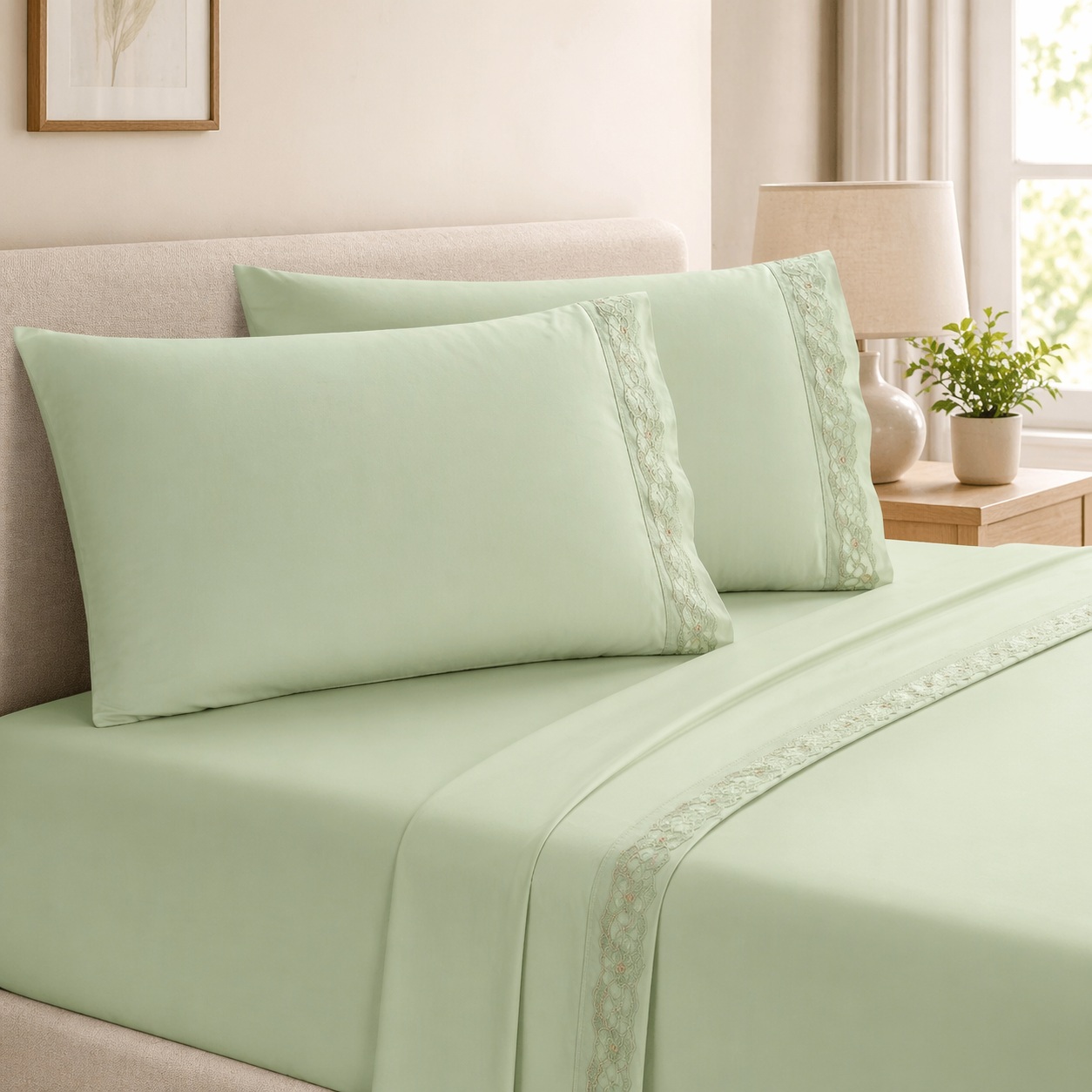
A bamboo cooling bedding set typically comes in multiple configurations: 4-piece sets (flat sheet, fitted sheet, two pillowcases) and 5-piece sets (4-piece plus a duvet or quilt). Five-piece sets are particularly popular for summer because the lightweight bamboo quilt provides coverage without overheating — the quilt itself is made from breathable bamboo fabric that actively cools rather than trapping heat.
When selecting a bamboo bedding set queen option, check the fitted sheet depth. A bamboo bedding set queen or bamboo cooling bedding set king size should have deep pockets (at least 15 inches / 38 cm) to accommodate thicker mattresses, including pillow-top and memory foam models. Many customers report that cheap bamboo sheets fail precisely because the fitted sheet is too shallow — a problem that good manufacturers avoid by designing for modern mattress depths.
For bamboo cooling bedding set king size purchases, pay attention to the number of pillowcases included. King-sized beds often use two king pillows or four standard pillows, so you may need to confirm coverage. A bamboo cooling bedding set that includes four pillowcases is ideal for couples with different pillow preferences.
If you have an unusually deep mattress or an adjustable bed base, look for bamboo bedding sets for hot sleepers with extra-deep fitted sheets and generous elastic all the way around the edges — not just corner straps. These details make a genuine difference in how well the set stays in place.
Durability and Care Instructions
A well-made bamboo cooling bedding set can last for years with proper care. Here is what you need to know:
-
Washing – Machine wash your bamboo cooling bedding set in cool or warm water (maximum 30°C / 86°F). Use a mild, eco-friendly liquid detergent. Avoid bleach, fabric softener, and dryer sheets — these coat bamboo fibers and can reduce their natural moisture-wicking and breathability.
-
Drying – Tumble dry on low heat or, better yet, line dry. High heat damages bamboo fibers over time and can cause shrinkage. If you must use a dryer, remove the set while it is still slightly damp and allow it to air-dry completely.
-
Softening over time – One notable advantage of a bamboo cooling bedding set is that it actually gets softer with each wash — unlike cotton, which can become rough and pilled after repeated laundering. Many users report that their best bamboo cooling bedding set feels better six months after purchase than it did on day one.
-
Avoid – Do not use chlorine bleach on bamboo bedding; it breaks down the natural bamboo fibers. Do not iron bamboo bedding; it wrinkles less than cotton anyway, and ironing is unnecessary.
With reasonable care, a quality bamboo cooling bedding set should last three to five years before showing significant signs of wear. Given the improved sleep quality it delivers, that is an excellent return on investment.
Who Benefits Most from Bamboo Cooling Bedding
The term “hot sleeper” covers a broad range of people. Here is who will benefit most from switching to a bamboo cooling bedding set:
-
Night sweat sufferers – If you regularly wake up with damp sheets, your body is struggling to regulate temperature during sleep. A bamboo cooling bedding set actively pulls moisture away from your skin and promotes evaporation — often enough to break the night-sweat cycle entirely.
-
Perimenopausal and menopausal women – Hot flashes and night sweats are among the most disruptive symptoms of hormonal change. A bamboo cooling bedding set can help manage the severity of nighttime hot flashes by keeping the sleeping environment consistently cooler and drier.
-
People in warm climates – Anyone living in tropical, subtropical, or consistently warm regions will immediately appreciate the cooling effect of bamboo bedding. Unlike cotton sheets that can feel sticky in humidity, a bamboo cooling bedding set stays dry and comfortable.
-
Couples with different temperature preferences – If one partner sleeps hot and the other sleeps cold, bamboo’s thermoregulating properties can be a compromise: the hot sleeper stays cool, while the cold sleeper does not freeze. Bamboo does not over-cool the way some synthetic “cooling” fabrics do.
-
Allergy and asthma patients – The moisture-wicking and antimicrobial properties of a cooling bedding set prevent the damp conditions that dust mites and mold require to thrive. Many allergy sufferers report noticeable symptom improvement after switching to bamboo.
Environmental Considerations
From an environmental perspective, bamboo has notable advantages over cotton. Bamboo grows rapidly — up to three feet per day — requires no pesticides or fertilizers in most growing conditions, and regenerates without replanting. It also uses significantly less water than cotton to produce the same amount of fiber.
However, processing bamboo into fabric is not without environmental cost. Traditional bamboo viscose production uses sodium hydroxide and carbon disulfide — chemicals that must be properly contained and treated to prevent environmental contamination. The more expensive bamboo lyocell process uses a closed-loop system that recovers over 99% of solvents, dramatically reducing waste and chemical discharge.
For environmentally conscious buyers seeking the best bamboo cooling bedding set, look for OEKO-TEX Standard 100 certification (which confirms the fabric is free from harmful substances) or FSC certification for bamboo sourcing. These third-party certifications assure that your bamboo cooling bedding set was manufactured responsibly.
When compared to cotton — which consumes massive amounts of water (up to 2,700 liters to produce one cotton t-shirt) and often relies on pesticide-intensive farming — even conventional bamboo viscose has a lower environmental impact per unit of fiber produced. Bamboo also releases 30% more oxygen and absorbs five times more carbon dioxide than equivalent stands of trees, according to some environmental studies. For sleepers who prioritize both comfort and ecological responsibility, bamboo bedding remains one of the best natural-fiber options available.
Market Trends and Real-World Feedback
The global bedding market was estimated at USD 41.9 billion in 2025, and the home bedding market is projected to grow from USD 119.39 billion in 2025 to USD 249.62 billion by 2035, at a CAGR of 7.5%. Within this growth, the bamboo bedding segment represents one of the fastest-expanding categories. The bamboo sheet market specifically is projected to expand at a CAGR of 8.2% from 2025 to 2033, reaching a forecast market size of USD 4.1 billion.
Online reviews consistently highlight the same benefits:
-
A verified purchaser noted that a bamboo sheet set was “remarkably cool to the touch and feel absolutely luxurious to lie on” and that the sheets became “softer with washing”.
-
Another reviewer wrote that after switching to bamboo bedding, “no more tossing and turning all night, pulling bed covers off then on then off again”.
-
A third customer observed that despite the silky sheen, the bedding “does not make you feel hot and sweaty during sleep; it does have a very comfortable cooling effect in use”.
Industry experts agree. Hayley Worley, founder of Sheet Society, has stated, “Bamboo sheets are cooling and super comfy — it’s kind of a no-brainer” for hot sleepers.
FAQ
Q1: Is a bamboo cooling bedding set actually cool to sleep on?
Yes. Bamboo fibers have high thermal conductivity and breathability that actively pull heat away from your body. Independent lab tests confirm bamboo can dissipate heat up to 30% faster than cotton.
Q2: What is the difference between bamboo viscose and bamboo lyocell for cooling?
Bamboo lyocell uses a closed-loop manufacturing process that is more eco-friendly. Both offer excellent cooling, but lyocell typically provides better moisture management and durability — it is generally the better choice for those seeking both cooling performance and sustainability.
Q3: Can I put a bamboo cooling bedding set in the washing machine?
Yes. Machine wash on cool or warm (max 30°C / 86°F) using mild liquid detergent. Avoid bleach, fabric softener, and high-heat drying. Tumble dry low or line dry.
Q4: Will a bamboo bedding set keep me warm in winter too?
Yes. Bamboo is thermoregulating, meaning it adapts to your body temperature — keeping you cool in summer and comfortable in winter. Many users find bamboo bedding comfortable year-round.
Q5: How long will a quality bamboo cooling bedding set last?
With proper care, three to five years or more. Bamboo bedding actually gets softer with each wash, unlike cotton, which can become rough and pilled over time.
Conclusion
A bamboo cooling bedding set delivers on its promise: better moisture-wicking, superior breathability, genuine thermoregulation, and a silky-soft feel that millions of hot sleepers have already discovered. The science is clear, the customer reviews are consistent, and the market growth reflects a product that solves a real problem. Whether you choose bamboo viscose for affordability or bamboo lyocell for premium sustainability, the best bamboo cooling bedding set will transform how you sleep during warm nights and beyond.
Ready to experience cooler, more comfortable sleep for yourself? Contact us today to request samples, discuss custom sizes and fabric options, or place wholesale orders. Don’t let another night of overheating ruin your rest — upgrade to a bamboo cooling bedding set made for hot sleepers.